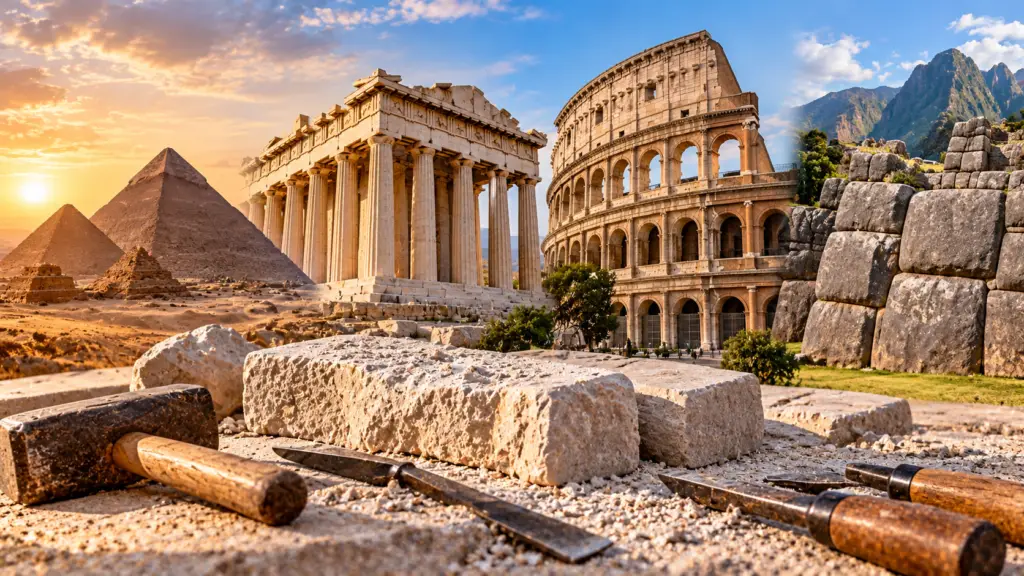
Some of the oldest human structures still standing are made of stone, and that is no accident. Builders in Egypt, Greece, Rome, and the Andes solved problems of strength, precision, and beauty with hand tools, and many of their answers still hold up.
Ancient stonework is more than a history lesson. The techniques behind it continue to shape how stone is cut, carved, and installed today, from restored landmark facades to hand-carved details in modern homes.
A Brief History of Ancient Stonework
Stone became a material of permanence because it outlasts almost everything else humans build. Civilizations that wanted their temples, tombs, and monuments to endure chose stone, and many of those structures have survived for thousands of years.
Each culture developed its own approach, shaped by nearby stone, the tools of the era, and what the builders wanted their work to say. The results range from massive pyramids to finely carved temple columns.
Egypt: Scale and Precision
The pyramids at Giza, built roughly 4,500 years ago, remain the most famous example of ancient stonework. Builders quarried enormous blocks of limestone and granite, then shaped and set them with remarkable accuracy.
Working with copper tools, stone pounders, and abrasive sand, Egyptian masons achieved tight joints and smooth casing surfaces. Their work showed that careful planning and patient technique could overcome the limitations of their tools.
Greece: Proportion and Refinement
Greek builders turned stonework into an art of proportion. Temples like the Parthenon, built from marble, used subtle refinements, such as columns that swell slightly toward the middle (a detail known as entasis), so the structure would look perfectly straight to the eye.
Greek masons fitted blocks without mortar, joining them with metal clamps set in lead. The level of finish they achieved in marble set a standard for carving that sculptors and stonemasons still study.
Rome: Engineering at Scale
Romans combined Greek refinement with engineering ambition. They used the arch, the vault, and the dome to span spaces no one had spanned before, and they built extensively in travertine, the stone that clads the Colosseum.
Roman builders also standardized methods, allowing stonework to spread across the empire. Their influence shows up in classical architecture worldwide, including many of New York’s civic and institutional buildings.
The Inca: Fit Without Mortar
In the Andes, Inca masons perfected a technique that still puzzles visitors. At sites like Sacsayhuamán and Cusco, walls are built from irregular, many-sided stones fitted so tightly that the joints are famously hard to slip a blade into.
That precision made the walls exceptionally stable, and many have survived centuries of earthquakes. It is one of history’s clearest examples of how skill and patience can replace mortar entirely.
Core Techniques That Survived
Across these cultures, a handful of core methods recur. Quarrymen split stone along its natural grain using wedges, a principle stonecutters still rely on today.
Carvers shaped surfaces with a progression of chisels, from pointed tools for roughing out to toothed and flat chisels for refining, then smoothed the stone with abrasives. Joinery such as dry fitting, clamps, and interlocking cuts held structures together without depending on mortar.
These methods share one idea: understand the stone first, then work with its character instead of against it. That principle sits at the heart of traditional stone craftsmanship.
Why Ancient Techniques Still Matter Today
Modern tools have changed the speed of stonework, not its fundamentals. A CNC machine can cut a profile quickly, but reading a slab, judging its grain, and hand-finishing a carved detail still depend on knowledge passed down through generations.
Ancient methods also matter for preservation. Restoring a historic facade or replacing a damaged carving requires matching the original techniques, finishes, and proportions, which is impossible without understanding how the work was first done.
Traditional Carving Methods in Modern Design
Today’s best stonework blends both worlds. Machines handle precise, repeatable cuts and large-scale production, while skilled carvers add the detail, character, and hand finish that machines cannot replicate.
That combination appears in carved mantels and fireplace surrounds, moldings and cornices, lettering and seals, and restored architectural ornament. The result keeps the depth of traditional work while meeting modern timelines and specifications.
Inspiration From Ancient Stone Architecture
Designers continue to borrow from ancient stone architecture because its lessons are timeless. Greek proportion informs how columns and facades are balanced, Roman arches and vaults still frame entrances and interiors, and the Inca approach to precise joinery inspires clean, seamless installations.
Material choices follow the same logic. Limestone, marble, granite, and travertine, the stones ancient builders trusted, remain central to high-end architectural stonework because they age gracefully and last for generations.
Carrying the Tradition Forward in New York
New York’s architecture is full of buildings that draw on classical stone traditions, and keeping them alive takes craftspeople who know the old methods. Petrillo Stone Corporation has worked from the same Mount Vernon shop since 1926, after founding it in 1907.
Its history includes hand-carved limestone for Fordham University’s Keating Hall in the 1930s and travertine fabricated for Lincoln Center in the 1960s. Discoverhow we blend traditional and modern stonework to bring that same craftsmanship to new projects and restorations.
Frequently Asked Questions
Why are ancient stonework techniques still relevant today?
They rest on unchanging principles: reading the stone, working with its grain, and fitting pieces precisely. They are also essential for restoring historic buildings, where new work must match the original methods and finishes.
How are traditional stone carving methods used in modern designs?
Machines handle precise, repeatable cuts, while skilled carvers add hand-finished detail. The blend shows up in carved mantels, moldings, cornices, lettering, and restored architectural ornament.
What inspiration can be drawn from ancient stone architecture?
Designers borrow Greek proportion, Roman arches and vaults, and Inca-style precise joinery. Ancient builders favored stones such as limestone, marble, granite, and travertine, which remain the foundation of high-end stonework today.