Most people commissioning stonework picture the finished countertop or facade, not the weeks of precise work that get it there. Understanding the process helps you set realistic timelines, ask better questions, and spot a fabricator who cuts corners.
Natural stone fabrication in NY follows a clear sequence, from the first slab selection to the final installed piece. Here is what actually happens at each stage, and how long to expect it to take.
What Natural Stone Fabrication Actually Means
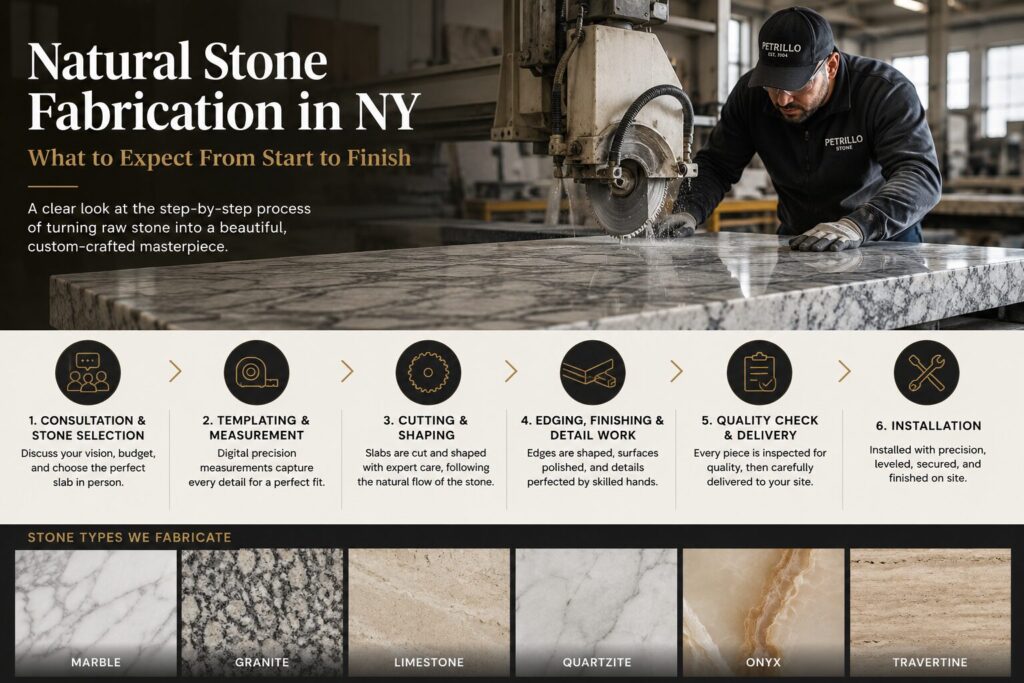
Fabrication is the work of transforming a raw quarried slab into a finished, installed piece. It covers selection, measurement, cutting, shaping, finishing, and installation, each handled to your project’s exact specifications.
A raw slab is not a countertop. Getting from one to the other takes skilled hands, calibrated machinery, and a shop that controls quality at every step rather than rushing the piece out the door.
Step 1: Consultation and Stone Selection
Every project starts with a conversation about scope, budget, and the look you want. From there, you select the actual material, ideally viewing full slabs in person rather than small samples.
Seeing the whole slab matters because natural stone varies from block to block. The vein you fall for in one slab may not appear in the next, so choosing the specific piece is part of the design.
Step 2: Templating and Measurement
Once the stone is chosen, the fabricator templates your space, usually with digital measuring tools that capture exact dimensions, angles, and cutouts for sinks or cooktops.
This step is where accuracy is won or lost. New York interiors are rarely square, and pre-war buildings settle over time, so precise templating prevents gaps and forced fits later.
Step 3: Cutting and Shaping
With a template in hand, the slab is cut to size. Skilled fabricators read the stone first, planning cuts around natural fissures and positioning veins so they run continuously across seams and waterfall edges.
Good cutting is as much judgment as machinery. A careless cut wastes expensive material and can leave a weak point that shows up years down the line.
Step 4: Edging, Finishing, and Detail Work
Next come the edges, the polish, and any carved detail. Edge profiles range from simple eased edges to elaborate ogee and bullnose shapes, matched to the surrounding cabinetry or architecture.
This is where craftsmanship separates shops. Tight seams, a consistent polish, and clean edge work are the marks of a fabricator who takes the finish seriously.
Step 5: Quality Check and Delivery
Before anything leaves the facility, the finished piece should be inspected for dimensions, finish quality, and structural soundness. Delivery is then coordinated around the realities of the job site.
In New York, that means planning for loading-dock windows, freight elevators, walk-up buildings, and narrow delivery schedules. A fabricator who knows the city builds those constraints into the plan.
Step 6: Installation
Installation sets the piece in place, levels it, secures it, and finishes the seams on site. Undermount sinks are supported correctly, and joints are placed where the eye is least likely to catch them.
A clean install is the payoff for all the earlier precision. When templating and fabrication are done right, installation is straightforward rather than a scramble.
How Long Natural Stone Fabrication Take in New York
Timelines vary with material availability, project size, and the complexity of the edge and detail work. As a general industry range, not a fixed promise, most residential projects run roughly two to four weeks from templating to installation.
Larger commercial jobs, rare materials, or intricate custom detail extend that window. Rushing the schedule usually shows up in the quality, so a realistic timeline protects the result.
Stone Types: Marble, Granite, Limestone, and More
Nearly any natural stone can be fabricated, and the choice depends on the application. Marble fabrication in NY remains the classic for luxury interiors, valued for its depth and movement. Granite fabrication in New York suits kitchens and exteriors that demand hardness and weather resistance.
Limestone brings an understated, architectural tone favored for facades and lobbies, while quartzite offers marble’s drama with far greater durability. Onyx and travertine round out the options for accent and specialty work.
Custom Fabrication for Homeowners
Homeowners are not limited to stock sizes and standard edges. Custom work means selecting an individual slab, specifying exact dimensions, and choosing the finish and edge profile that fit your space.
Petrillo’s work on custom stone fabrications for homeowners brings the same craftsmanship found in landmark commercial interiors into private residences.
Cast Stone vs Natural Stone Fabrication
Not every project calls for quarried stone. Cast stone, molded from a stone mixture, is faster and more affordable but limited in fine detail. Natural stone, carved from solid blocks, allows for intricate detail and unique veining.
If you are weighing the two, our guide to cast natural stone explains where each option makes sense.
Why Work With a New York Fabrication Specialist
Fabrication quality depends on experience, in-house control, and knowledge of how stone behaves over time. A specialist who owns every step, from slab to installation, is accountable for the whole result.
For architects, contractors, and homeowners who want that level of control, Petrillo offers premier natural stone services in NY, backed by more than a century of stonework on the city’s most recognizable buildings.
Frequently Asked Questions
What is natural stone fabrication, and what does the process involve?
Fabrication turns a raw quarried slab into a finished, installed piece. The process covers selection, digital templating, cutting, edge shaping, polishing, quality inspection, and installation, all to your project’s specifications.
How long does natural stone fabrication take in New York?
Most residential projects take roughly 2 to 4 weeks from templating to installation, depending on material availability, project size, and edge details. Complex or custom work takes longer.
Which types of stone can be fabricated, such as marble, granite, or limestone?
All three can be fabricated from quartzite, onyx, travertine, and more. Marble, granite, and limestone are the most common choices for interior and exterior applications in New York.
Is custom stone fabrication available for homeowners in NY?
Yes. Homeowners can select individual slabs and specify dimensions, edges, and finishes for fully custom results rather than settling for stock sizes.
What is the difference between cast stone and natural stone fabrication?
Natural stone is quarried and carved from solid blocks, which allows for fine detail and unique veining. Cast stone is molded from a stone mixture, which is faster and cheaper but limited in detail.