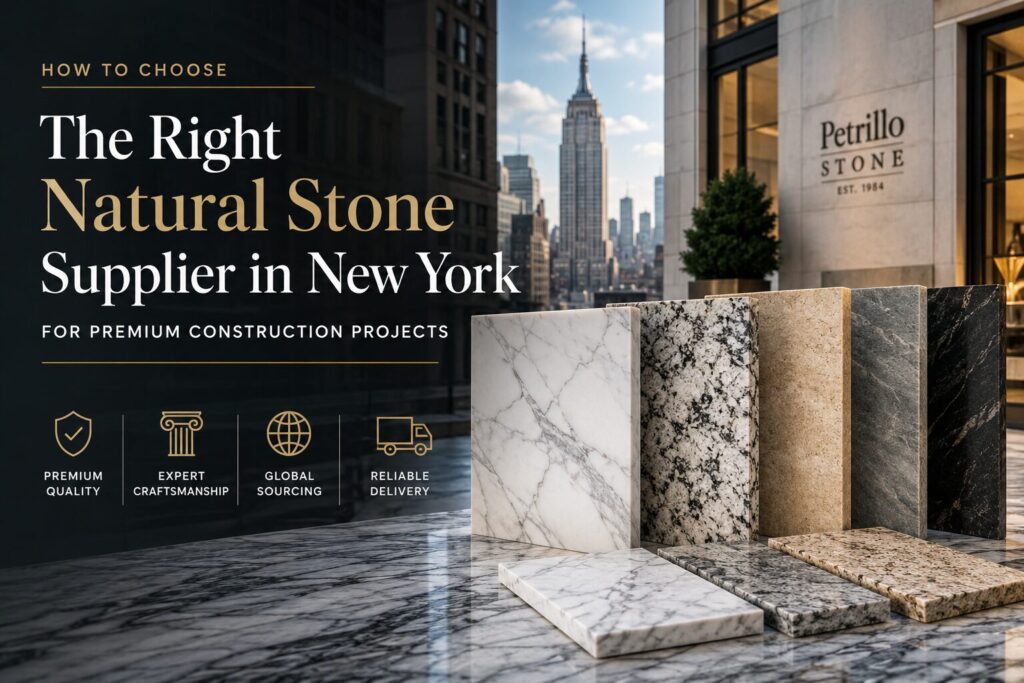
Premium construction does not forgive shortcuts, and the stone you specify is one of the most visible, permanent decisions in the entire build. The right slab, cut and set correctly, can anchor a lobby or a kitchen for a century. The wrong supplier can cost you weeks, blow a budget, and leave seams and edges that no amount of polish will fix.
Choosing a natural stone supplier in New York is therefore less about price per square foot and more about capability, sourcing, and the ability to deliver on a real job site. Here is how to evaluate one properly before you commit a single drawing to it.
Why the Supplier Decision Carries the Project
On a high-end project, the stone supplier sits at the intersection of design intent, material quality, and installation reality. A weak link in any of those three breaks the result, and it usually breaks it late, when the cost of fixing it is highest.
Architects need a partner who can source the exact material a drawing calls for. Contractors need predictable lead times and pieces that fit the first time. Homeowners need craftsmanship that holds up to daily life. A serious supplier serves all three without dropping the standard for any of them.
The difference shows up in the details that clients remember: a seam placed where the eye never lands, an edge profile that matches the millwork, a vein that runs continuously across a waterfall island. None of that happens by accident.
What to Look For in a Natural Stone Supplier in New York
Not every stone yard is built for premium work. These are the markers that separate a fabricator who can carry a demanding project from one who cannot.
In-House Fabrication
Suppliers who fabricate on-site, ensuring control of quality at every step, from slab inspection to the final polish. When fabrication is outsourced, accountability scatters across vendors and timelines slip. Ask directly whether the company cuts, carves, and finishes in its own facility, or whether it brokers the work out to a third party.
A company that owns its fabrication also owns its mistakes, which means it has every incentive to get the piece right before it leaves the shop.
A Proven Track Record
Longevity signals reliability. A supplier with decades of completed work, especially on landmark buildings and recognizable interiors, has already solved the problems your project will run into—references and a deep portfolio matter more than a polished sales pitch.
Ask to see finished work that resembles yours in scope. A firm that has handled hotel lobbies, cultural institutions, and high-end residences has a depth of experience that a newer outfit simply cannot claim.
Material Sourcing and Selection
The best suppliers import directly from quarries across the United States and around the world, giving you genuine choice rather than whatever happens to be in stock. Direct sourcing also protects quality, since the company inspects the material before it ships rather than accepting surprises at delivery.
Wide sourcing matters most on premium projects, where a design often hinges on one specific block, one specific vein, or one rare color that a stocked-only supplier will never be able to find.
Logistics Built for New York
This is where many suppliers quietly fail. New York job sites come with loading-dock windows, walk-up buildings, freight elevators, landmark restrictions, and delivery schedules measured in narrow hours. Heavy stone does not move easily through any of that.
A supplier who understands the city’s plans around those constraints, rather than discovering them on install day. That experience is the difference between a clean delivery and a slab stranded on a sidewalk.
Red Flags That Signal the Wrong Supplier
A few warning signs tend to predict trouble. Watch for vague answers about where fabrication actually happens, a thin or generic portfolio, and reluctance to provide references.
Be cautious about pricing that comes in far below everyone else’s, since it usually means corners are being cut: thinner material, outsourced cutting, or rushed installation. On a premium build, the cheapest quote is rarely the real cost.
Stones That Define Premium New York Projects
Premium specifications tend to center on a handful of natural materials, each suited to different work.
Marble (Calacatta, Carrara, Statuario) remains the classic choice for luxury interiors, prized for its movement and depth. Granite delivers hardness and weather resistance for both kitchens and exteriors. Limestone offers an understated, architectural tone favored for facades and lobbies. Quartzite gives the drama of marble with far greater durability, which is why it appears in so many high-end kitchens.
The right pick depends on the application, the traffic, and the look, which is exactly why a supplier with broad inventory and honest guidance is worth more than one pushing whatever is on the floor.
Natural Stone, Engineered, and Cast Options
Premium projects almost always come back to natural stone, but it helps to understand the alternatives before you decide.
Engineered surfaces offer consistency and lower maintenance, which suits rental units and high-traffic commercial spaces. They cannot reproduce the depth, movement, or carving potential of the real thing.
Cast stone is a budget-friendly middle path, useful where speed matters more than fine detail. If you are weighing that route, our guide to cast natural stone walks through where it works and where it falls short. For statement work, natural stone stays the standard that the others are built to imitate.
Choosing Stone for Exterior Construction
Exterior stone has to survive New York weather, which means freeze-thaw cycles, moisture, and temperature swings that punish the wrong material.
Granite and limestone are the most dependable choices for facades, steps, and cladding. Both weather slowly, resist the elements, and have proven themselves on building exteriors across the city for generations. Quartzite and select marbles can also perform outdoors when they are specified and sealed correctly.
For exterior and landscape features, from entry steps to garden walls and courtyard paving, the same rule holds: choose a dense, durable stone and a supplier who knows how it behaves over decades. Petrillo landscaping and exterior stonework follow that principle on every project, indoors or out.
Custom Fabrication for Residential Projects
Homeowners pursuing premium results should expect more than stock sizes and standard edges. Custom work is where a fabricator earns its reputation.
That includes selecting an individual slab in person, templating an irregular pre-war layout, bookmatching panels for a feature wall, and finishing edges to a specific profile. Our work on custom stone fabrications for homeowners brings the same craftsmanship found in landmark commercial interiors into the home.
The payoff is a result that fits the space exactly and reads as designed rather than assembled, which is the whole point of going custom in the first place.
Why Petrillo Stone
Petrillo Stone Corporation has worked with New York stone for over a century, founded in 1907 and still run by the founding family. From its Mount Vernon facility, the company fabricates every piece on site, pairing Old World carving skill with modern technology.
Its stonework appears throughout the city, including the St. Regis Hotel, Rockefeller Center, and Lincoln Center, along with countless other landmark interiors and exteriors. For architects, contractors, and homeowners who treat stone as a defining element rather than an afterthought, that record is the point.
Frequently Asked Questions
What should I look for in a natural stone supplier in New York?
Look for in-house fabrication, decades of proven work, direct material sourcing, and the logistics experience to handle New York job sites. A strong portfolio across commercial and residential projects confirms they can deliver.
Why is natural stone better than engineered alternatives?
Natural stone offers genuine depth, one-of-a-kind veining, and carving detail that engineered surfaces only imitate. Every slab is unique, and quality stone lasts for generations rather than years.
Which natural stone is best for exterior construction?
Granite and limestone are the most reliable for New York exteriors, since both handle freeze-thaw cycles and resist weathering. Quartzite and certain marbles also perform well when properly specified and sealed.
Does Petrillo Stone offer custom stone fabrication?
Yes. Petrillo Stone fabricates every piece on site at its Mount Vernon facility, combining Old World craftsmanship with modern technology for both commercial and residential projects.