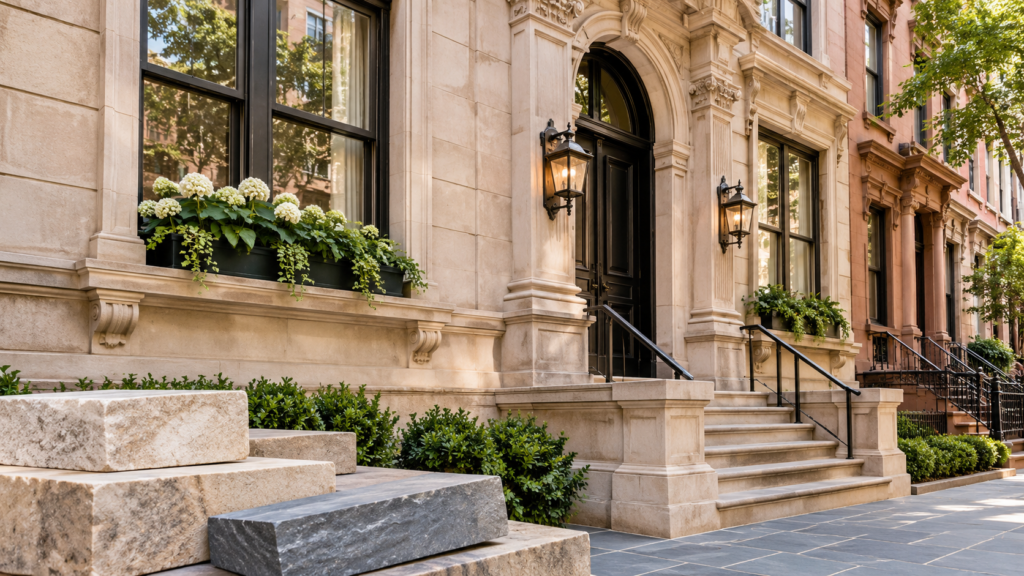
Cut stone shows up everywhere in the New York, New Jersey, and Connecticut region, usually in places people never think about. The sill under a brownstone window, the coping along a parapet, a set of limestone entry steps: each one was cut to a drawing, finished by hand or machine, and set to fit.
If you are specifying tri-state cut stone for a new building, a restoration, or a single replacement piece, the material and the shop that cuts it matter more than most buyers expect. Here is what to know before you order.
What Cut Stone Actually Is
Cut stone is natural stone that has been quarried and then shaped to exact dimensions for a particular use. The trade often calls it dimension stone. A rough block leaves the quarry, gets sawn into slabs or blanks, and is then cut, profiled, and finished to match shop drawings.
That last step is the whole point. A piece of cut stone is made for one spot on one building, with its size, edge profile, and surface finish set in advance.
Typical cut stone work includes window sills and lintels, door surrounds, copings and caps, stair treads and risers, cornices, quoins, and wall veneer. In older buildings, it also includes carved ornament and replacement units that must match what is already there.
Cut Stone vs Natural Stone: Clearing Up the Confusion
People often treat these as two different materials, and they are not. Cut stone is natural stone; the difference is how it’s processed. “Natural stone” describes where the material comes from, while “cut stone” describes what has been done to it.
The real contrast is with manufactured products. Cast stone is a molded concrete mix made to look like quarried stone, and engineered surfaces are also factory-made. Both have their uses, but neither weathers, ages, or carves the way genuine quarried stone does.
The Stones You See Most Across the Tri-State Area
The region’s buildings lean on a handful of materials, and each one earned its place.
Indiana limestone is the workhorse. It cuts cleanly, takes fine detail, and clads many of Manhattan’s prewar towers, including the Empire State Building. It is still a common choice for trim, entrances, and new facades.
Bluestone, quarried in New York and Pennsylvania, covers countless sidewalks, patios, treads, and coping stones. Granite handles the hardest jobs, such as base courses, curbs, and steps that take constant foot traffic and road salt.
Then there is brownstone. Much of the brownstone on New York’s nineteenth-century rowhouses came from quarries in Portland, Connecticut, and restoring it today means finding a good match or a carefully chosen substitute. Marble rounds out the list, mostly for interiors, monuments, and high-end detail.
Why the Region Is Hard on Stone
Winters here are tough on masonry. Water gets into pores and joints, freezes, expands, and slowly pries material apart. De-icing salt adds its own damage to steps and sidewalks.
A good fabricator accounts for that before cutting anything. That means choosing a stone with the right density and absorption for the location, sloping and drip-edging sills and copings so water runs off, and getting the joint details right. Pick the wrong stone for an exposed parapet, and you may replace it within a few winters.
How to Choose a Reliable Cut Stone Supplier
The quality of cut stone depends heavily on the shop that produces it. Start by asking whether the company fabricates in its own facility. A supplier who brokers work out to someone else can’t fully control accuracy, finish, or schedule.
Ask about shop drawings, too. A serious fabricator works from detailed drawings, has the architect review them, and cuts to them. For visible work, request samples of the actual stone and finish, and for larger jobs consider a mockup panel before full production.
Experience with older buildings is worth checking if your project involves restoration. Matching a century-old limestone cornice or a weathered brownstone stoop takes judgment that comes only from doing it many times. If the building sits in a landmark district, the supplier should be comfortable working within the approvals process that comes with it.
Finally, look at logistics. Heavy stone has to reach tight city sites, and a supplier who knows the region plans deliveries around access, street permits, and crane or hoist schedules. For a closer look at how shaping and finishing work in practice, see our overview of custom stone fabrication in NY.
The Case for Working With a Stone Corp in the USA
Plenty of stone is quarried overseas, and imported material has an important place in high-end work. Where fabrication happens is a separate question, and working with a stone corp in the USA close to the project offers real advantages.
The first is time. Pieces cut abroad have to clear shipping and customs, and if one arrives damaged or wrong, the replacement goes through the same wait. A local shop can recut a piece in days.
The second is oversight. You can visit a domestic shop, inspect slabs, approve a sample in person, and talk to the people doing the cutting. That level of access is rare when production happens on another continent.
Matching existing work is the third. A regional fabricator has likely handled the same limestones, bluestones, and brownstones already on your block, and knows where to source a close match. Clear communication, US contracts, and familiarity with local codes simplify the whole process.
Where Petrillo Stone Fits In
Petrillo Stone Corporation has cut stone for the Tri-State area since 1907, and its shop has operated from the same Mount Vernon, New York location since 1926. The company imports and supplies stone, fabricates it on site, and installs it, so one team stays responsible from the first drawing to the last joint.
That history includes hand-carved limestone for Fordham University’s Keating Hall in the 1930s and travertine for Lincoln Center in the 1960s, along with work at Rockefeller Center and the St. Regis Hotel. For architects, contractors, and owners in New York, New Jersey, and Connecticut, it is a local shop with a very long track record.
Frequently Asked Questions
What is the difference between cut stone and natural stone?
Cut stone is natural stone that has been quarried and shaped to exact dimensions for a specific use, such as a sill, step, or coping. “Natural stone” refers to the material’s origin, while “cut stone” refers to how it’s been processed. The real alternative is a manufactured product such as cast stone.
How can you choose reliable cut stone suppliers in the Tri-State area?
Look for in-house fabrication, detailed shop drawings, physical samples of the stone and finish, and experience with buildings like yours. For restoration, ask about matching historic stone. Also confirm the supplier can manage deliveries to tight urban sites.
What are the benefits of ordering from USA-based stone companies?
Shorter lead times, faster replacements, in-person inspections, and easier communication. A regional shop also knows the local stones and building codes, which helps when matching existing work.